
The trihydroxybenzenes (or benzenetriols) are organic compounds with the formula C6H3(OH)3. Also classified as polyphenols, they feature three hydroxyl groups substituted onto a benzene ring. They are white solids with modest solubility in water.[1]
Pyrogallol Hydroxyquinol Phloroglucinol Benzene-1,2,3-triol Benzene-1,2,4-triol Benzene-1,3,5-triol 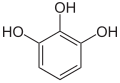


In biochemistry
editThe enzyme pyrogallol hydroxytransferase transforms benzene-1,2,3-triol (pyrogallol) into benzene-1,3,5-triol (phloroglucinol) and vice versa.[2] It uses benzene-1,2,3,5-tetrol as a cosubstrate, thanks to which it achieves a non-redox transhydroxylation.[3] This enzyme can be found in Pelobacter acidigallici.[4][5]
See also
editReferences
edit- ↑ Helmut Fiege; Heinz-Werner Voges; Toshikazu Hamamoto; Sumio Umemura; Tadao Iwata; Hisaya Miki; Yasuhiro Fujita; Hans-Josef Buysch; Dorothea Garbe; Wilfried Paulus (2002). "Phenol Derivatives". Ullmann's Encyclopedia of Industrial Chemistry. Weinheim: Wiley-VCH. doi:10.1002/14356007.a19_313. ISBN 978-3-527-30673-2.
- ↑ Enzyme 5.4.4.9 at KEGG Pathway Database.
- ↑ Reichenbecher, Wolfram; Schink, Bernhard (1999-03-19). "Towards the reaction mechanism of pyrogallol–phloroglucinol transhydroxylase of Pelobacter acidigallici". Biochimica et Biophysica Acta (BBA) - Protein Structure and Molecular Enzymology. 1430 (2): 245–253. doi:10.1016/S0167-4838(99)00004-7. ISSN 0167-4838.
- ↑ "P 80564 Pyrogallol hydroxytransferase small subunit". UniProtKB. Uniprot.
- ↑ Schink, B.; Pfennig, M. (December 1982). "Fermentation of trihydroxybenzenes by Pelobacter acidigallici gen. nov. sp. nov., a new strictly anaerobic, non-sporeforming bacterium". Archives of Microbiology. 133 (3): 195–201. doi:10.1007/BF00415000. S2CID 15717780.

This set index article lists chemical compounds articles associated with the same name.
If an internal link led you here, you may wish to change the link to point directly to the intended article.
If an internal link led you here, you may wish to change the link to point directly to the intended article.
 | This article about an aromatic compound is a stub. You can help Wikipedia by adding missing information. |