
Alexander Jagiellon (Polish: Aleksander Jagiellończyk; Lithuanian: Aleksandras Jogailaitis; 5 August 1461 – 19 August 1506) was Grand Duke of Lithuania from 1492 and King of Poland from 1501 until his death in 1506.[4] He was the fourth son of Casimir IV Jagiellon and a member of the Jagiellonian dynasty. Alexander was elected the Grand Duke of Lithuania upon the death of his father per his father's suggestion, and became the King of Poland upon the death of his elder brother John I Albert.
| Alexander Jagiellon | |
|---|---|
.jpg) As king of the Saracens, probably the most accurate portrait of Alexander, c. 1504[1] | |
| Grand Duke of Lithuania | |
| Reign | 30 July 1492 – 19 August 1506 |
| Predecessor | Casimir |
| Successor | Sigismund |
| Co-ruler | John Albert (disputed)[a] |
| King of Poland | |
| Reign | 3 October 1501 – 19 August 1506 |
| Coronation | 12 December 1501 in Wawel Cathedral |
| Predecessor | John I Albert |
| Successor | Sigismund I the Old |
| Born | 5 August 1461 Kraków, Poland |
| Died | 19 August 1506 (aged 45) Vilnius, Lithuania |
| Burial | |
| Spouse | Helena of Moscow |
| Dynasty | Jagiellon |
| Father | Casimir IV Jagiellon |
| Mother | Elizabeth of Hungary |
| Signature |  |
Early life
editAlexander was born as the fourth son of King Casimir IV Jagiellon and Elizabeth of Austria, daughter of the King Albert II of Germany. At the time of his father's death in 1492, his eldest brother Vladislaus had already become king of Bohemia (1471) and Hungary and Croatia (1490), and the next oldest brother, Saint Casimir, had died (1484) after leading an ascetic and pious life in his final years, resulting in his eventual canonisation.
At his deathbed King Casimir recommended that John Albert to be chosen as his successor in Poland, while Alexander would become the next ruler of Lithuania. Per rules of the political union between Poland and Lithuania, the choice of the monarch of each country should have not happened without consent of the nobles from the other country. However, the Lithuanians chose to elect Alexander to be their Grand Duke in July 1492 without consulting Polish nobility (szlachta). On 27 August 1492 John Albert was elected in Poland as the new King and, while accepting his brother's position in Lithuania, he claimed the status of dominant co-ruler over him as the Supreme Duke,[5] which was recognized by Alexander but not by Lithuanian Council of Lords.[6]
Alexander maintained a Lithuanian court and multiple Lithuanian priests served in his royal chapel of the Polish royal court.[7][8][9]
Grand Duke of Lithuania (1492–1506)
editThe greatest challenge that Alexander faced upon assuming control of the grand duchy was an attack on Lithuania by Grand Duke Ivan III of Russia and his allies, the Crimean Khanate's Tatars, which commenced shortly after his accession. Ivan III considered himself the heir to the lands of Kievan Rus', and was striving to take back the territory previously gained by Lithuania.[10] Unable to successfully stop the incursions, Alexander sent a delegation to Moscow to make a peace settlement, which was signed in 1494 and ceded extensive land over to Ivan. In an additional effort to instill peace between the two countries, Alexander was betrothed to Helena, the daughter of Ivan III; they were married in Vilnius on 15 February 1495. The peace did not last long, however, as Ivan III resumed hostilities in 1500. The most Alexander could do was to garrison Smolensk and other strongholds and employ his wife Helena to mediate another truce between him and her father after the disastrous Battle of Vedrosha (1500). In the terms of this truce, which was concluded on 25 March 1503, Lithuania had to surrender about a third of its territory to the nascent expansionist Russian state; Alexander pledged not to touch lands including Moscow, Novgorod, Ryazan, and others, while a total of 19 cities were ceded.[11] Historian Edvardas Gudavičius said:
"The war of 1492–1494 was a kind of reconnaissance mission conducted by the united Russia. [The terms of] the ceasefire of 1503 showed the planned political aggression of Russia, its undoubted military superiority. The concept of the sovereign of all Russia, put forward by Ivan III, did not leave room for the existence of the Lithuanian state".[11]
Also King of Poland (1501–1506)
editOn 17 June 1501, Alexander's older brother John I Albert died suddenly. Alexander was elected the King on 3 October and crowned on 12 December of the same year.[12] Alexander's shortage of funds immediately made him subservient to the Polish Senate and szlachta, who deprived him of control of the mint (then one of the most lucrative sources of revenue for the Polish kings), curtailed his prerogatives, and generally endeavored to reduce him to a subordinate position. In 1505, the Sejm of the Kingdom of Poland passed the Act of Nihil novi, which forbade the king to issue laws without the consent of the nobility, represented by the two legislative chambers, except for laws governing royal cities, crown lands, mines, fiefdoms, royal peasants, and Jews. This was another step in Poland's progression towards a "Noble's Democracy".
During Alexander's reign, Poland suffered additional humiliation at the hands of its subject principality, Moldavia. Only the death of Stephen III of Moldavia, the great hospodar of Moldavia, enabled Poland still to hold her own on the Danube river. Meanwhile, the liberality of Pope Julius II, who issued no fewer than 29 bulls in favor of Poland and granted Alexander Peter's Pence and other financial help, enabled him to restrain somewhat the arrogance of the Teutonic Order.
Alexander Jagiellon never felt at home in Poland, and bestowed his favor principally upon his fellow Lithuanians, the most notable of whom was the wealthy Lithuanian magnate Michael Glinski, who justified his master's confidence by his great victory over the Tatars at Kletsk (5 August 1506), news of which was brought to Alexander on his deathbed in Vilnius.
According to Giedrė Mickūnaitė, interwar Lithuanian historians assumed that Alexander was the last ruler of the Gediminid dynasty who understood the Lithuanian language, yet did not speak it, but there is a lack of sources regarding that.[13]
In 1931, during the refurbishment of Vilnius Cathedral, the forgotten sarcophagus of Alexander was discovered and has since been put on display.
Gallery
edit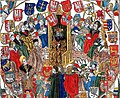 King Alexander in Polish Senate, 1506.

 Crown and sword of Alexander Jagiellon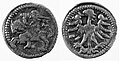
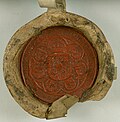 Seal of Alexander Jagiellon, 1504
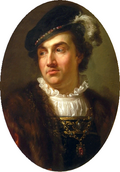 Fantasy portrait by Bacciarelli
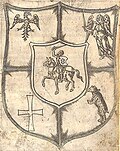 Coat of arms
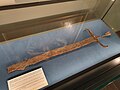 Sword of Alexander Jagiellon in 2023
.jpg)


_and_the_Polish_Eagle.jpg)
_and_other_coats_of_arms,_1504.jpg)

.jpg)

See also
editReferences
edit- ↑ Marcin Latka. "Detail of Miracle of Saint Simeon Stylites". artinpl. Archived from the original on 27 July 2019. Retrieved 31 May 2019.
- ↑ Baczkowski, Krzysztof (1999). Wielka historia Polski. Tom 3: Dzieje Polski późnośredniowiecznej (1370 - 1506). Fogra Oficyna Wydawnicza. p. 277. ISBN 83-7311-075-5.
- ↑ "aukščiausiasis kunigaikštis". Visuotinė lietuvių enciklopedija. Retrieved 13 June 2026.
{{cite web}}: CS1 maint: url-status (link) - ↑ Jerzy Jan Lerski; Piotr Wróbel; Richard J. Kozicki (1996). Historical dictionary of Poland, 966–1945. Greenwood Publishing Group. ISBN 978-0-313-26007-0.
- ↑ Baczkowski, Krzysztof (1999). Wielka historia Polski. Tom 3: Dzieje Polski późnośredniowiecznej (1370 - 1506). Fogra Oficyna Wydawnicza. p. 277. ISBN 83-7311-075-5.
- ↑ "aukščiausiasis kunigaikštis". Visuotinė lietuvių enciklopedija. Retrieved 13 June 2026.
{{cite web}}: CS1 maint: url-status (link) - ↑ Dubonis, Artūras (2016). "The Prestige and decline of the official (state) language in the Grand Duchy of Lithuania (15th-16th century): problems in Belarusian historiography". Lithuanian Historical Studies. 20: 7. doi:10.30965/25386565-02001002. Retrieved 3 November 2023.
- ↑ Pietkiwicz, K. (1997). Dwór litewski wielkiego księcia Aleksandra Jagiellończyka (1492–1506).
- ↑ Kiaupa, Zigmantas; Mickevičius, Arturas; Sarcevičienė, Jolita (1997). Lietuvos valstybė: XII-XVIII a. (in Lithuanian). Lietuvos istorijos institutas. pp. 88–89. ISBN 978-9986-780-08-3.
- ↑ Kort, Michael (2008). A Brief History of Russia. Infobase Publishing. p. 26. ISBN 978-1-4381-0829-2.
- 1 2 Shaikhutdinov, Marat (23 November 2021). Between East and West: The Formation of the Moscow State. pp. 145–179. doi:10.2307/j.ctv249sgn2.
- ↑ Besala, Jerzy (2006). Małżeństwa królewskie. Jagiellonowie (in Polish). Bellona Muza. p. 138. ISBN 8311105553.
- ↑ Statkuvienė, Regina. "Jogailaičiai. Kodėl ne Gediminaičiai?". 15min.lt (in Lithuanian). Retrieved 22 August 2021.
- ↑ Wawel Castle Archived 9 November 2016 at the Wayback Machine. History of the Royal Residence.
- ↑ John Albert styled himself as the Supreme Duke sometime after Alexander's election as the Grand Duke in July 1492.[2] His title was recognized by Alexander but not by Lithuanian Council of Lords.[3]
Bibliography
edit- This article incorporates text from a publication now in the public domain: Chisholm, Hugh, ed. (1911). "Alexander (king of Poland)". Encyclopædia Britannica. Vol. 1 (11th ed.). Cambridge University Press. p. 552.

External links
edit