
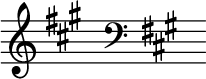
A major is a major scale based on A, with the pitches A, B, C♯, D, E, F♯, and G♯. Its key signature has three sharps. Its relative minor is F-sharp minor and its parallel minor is A minor.
| Relative key | F-sharp minor |
|---|---|
| Parallel key | A minor |
| Dominant key | E major |
| Subdominant key | D major |
| Component pitches | |
| A, B, C♯, D, E, F♯, G♯ | |
The A major scale is:

Changes needed for the melodic and harmonic versions of the scale are written in with accidentals as necessary. The A harmonic major and melodic major scales are:


In the treble, alto, and bass clefs, the G♯ in the key signature is placed higher than C♯. However, in the tenor clef, it would require a ledger line and so G♯ is placed lower than C♯.
Scale degree chords
editThe scale degree chords of A major are:
- Tonic – A major
- Supertonic – B minor
- Mediant – C-sharp minor
- Subdominant – D major
- Dominant – E major
- Submediant – F-sharp minor
- Leading-tone – G-sharp diminished
History
editAlthough not as rare in the symphonic literature as sharper keys (those containing more than three sharps), symphonies in A major are less common than in keys with fewer sharps such as D major or G major. Beethoven's Symphony No. 7, Bruckner's Symphony No. 6 and Mendelssohn's Symphony No. 4 comprise a nearly complete list of symphonies in this key in the Romantic era. Mozart's Clarinet Concerto and Clarinet Quintet are both in A major, along with his 23rd Piano Concerto, and generally Mozart was more likely to use clarinets in A major than in any other key besides E-flat major.[1] Moreover, the climax part of Tchaikovsky's Violin Concerto is also in A major.
The key of A occurs frequently in chamber music and other music for strings, which favor sharp keys. Franz Schubert's Trout Quintet and Antonín Dvořák's Piano Quintet No. 2 are both in A major. Johannes Brahms, César Franck, and Gabriel Fauré wrote violin sonatas in A major. In connection to Beethoven's Kreutzer Sonata, Peter Cropper said that A major "is the fullest sounding key for the violin."[2]
According to Christian Friedrich Daniel Schubart, A major is a key suitable for "declarations of innocent love, ... hope of seeing one's beloved again when parting; youthful cheerfulness and trust in God."[3]
For orchestral works in A major, the timpani are typically set to A and E a fifth apart, rather than a fourth apart as for most other keys. Hector Berlioz complained about the custom of his day in which timpani tuned to A and E a fifth apart were notated C and G a fourth apart, a custom which survived as late as the music of Franz Berwald.[4]
Notable compositions in A major
edit- Antonio Vivaldi
- Trio Sonata, Op. 1/9 RV 75
- Violin Sonata, Op. 2/2 RV 31
- concerto for two violins, Op. 3/5 RV 519
- concerto for violin, Op. 4/5 RV 347
- Violin Sonata, Op. 5/2 RV 30
- concerto for violin, Op. 9/2 RV 345
- concerto for violin, Op. 9/6 RV 348
- concerto for violin, Op. 11/3 RV 336
- Georg Philipp Telemann
- Fantasia for flute solo, No. 1
- Fantasia for violin solo, No. 5
- Fantasia for viola da gamba solo, No. 8
- Sonata for two flutes or two violins, No. 3
- Johann Sebastian Bach
- English Suite No. 1, BWV 806
- Wolfgang Amadeus Mozart
- Violin Concerto No. 5, K. 219
- Symphony No. 29, K. 201
- Symphony No. 21, K. 134
- Violin Sonata No. 22, K. 305
- Piano Sonata No. 11, K. 331
- String Quartet No. 18, K. 464
- Piano Concerto No. 23, K. 488
- Là ci darem la mano, duettino form Don Giovanni, K. 527
- Clarinet Quintet, K. 581
- Clarinet Concerto, K. 622
- Ludwig van Beethoven
- Symphony No. 7, Op. 92
- Piano Sonata No. 2, Op. 2/2
- Piano Sonata No. 28, Op. 101
- Violin Sonata No. 6, Op. 30/1
- Violin Sonata No. 9, Op. 47
- Cello Sonata No. 3, Op. 69
- String Quartet No. 5, Op. 18/5
- Franz Schubert
- Trout Quintet
- Piano Sonata, D 664
- Piano Sonata No. 20, D. 959
- Fanny Hensel
- Felix Mendelssohn
- Symphony No. 4, Op. 90 ("Italian")
- Organ Sonata, Op. 65, No. 3
- Frédéric Chopin
- Franz Liszt
- Piano Concerto No. 2, S.125
- Johannes Brahms
- Serenade No. 2, Op. 16
- Violin Sonata No. 2, Op. 100 ("Thun")
- Piano Quartet No. 2, Op. 26
- César Franck
- Anton Bruckner
- Émile Waldteufel
- Les Patineurs waltz, Op. 183
- Sergei Prokofiev
- Piano Sonata No. 6, Op. 82
- Dmitri Shostakovich
- String Quartet No. 2, Op. 68
- Symphony No. 15, Op. 141
See also
editReferences
edit- ↑ Mark Anson-Cartwright (2000). "Chromatic Features of E♭-Major Works of the Classical Period". Music Theory Spectrum. 22 (2): 178. JSTOR 745959.
- ↑ Peter Cropper, "Beethoven's Violin Sonata in A major, Op.47 'Kreutzer': First Movement", The Strad, March 2009, p. 64
- ↑ Rita Steblin (1996) A History of Key Characteristics in the Eighteenth and Early Nineteenth Centuries, University of Rochester Press, p. 123, ISBN 0835714187.
- ↑ Norman Del Mar (1981). Anatomy of the Orchestra, University of California Press, p. 349, ISBN 0520045009.
External links
edit Media related to A major at Wikimedia Commons
